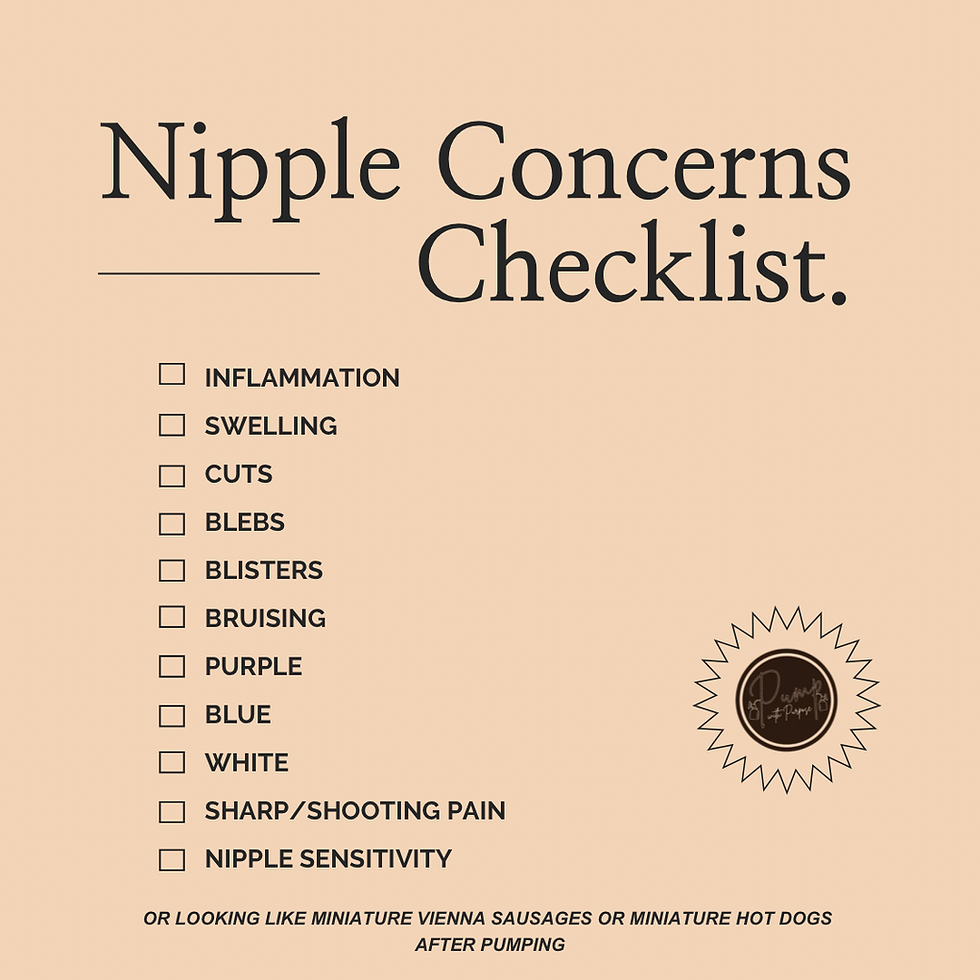

In a world saturated with health advice, where every organ system seems to have its own dedicated regimen of checks and balances, there remains a curious blind spot. A small, yet profoundly significant, part of our anatomy often overlooked, shrouded in a peculiar mix of modesty, discomfort, and perhaps, a lack of explicit instruction. We speak, of course, of the nipples – the overlooked sentinels of our breast health, the delicate indicators that often whisper secrets long before a shout is necessary.
This is the story of how we reclaim agency over this crucial, yet neglected, aspect of our well-being. It’s the narrative of transforming a once-taboo topic into a monthly ritual of empowerment, knowledge, and proactive self-care. It’s the story of Dr. Anya Sharma, a physician whose tireless advocacy for comprehensive, accessible health education led to the creation of what she affectionately terms, "The Nipple Health Checklist: 5 Things You Should Check Every Month."
Dr. Sharma’s journey began not in a textbook, but in the quiet, often tearful, conversations with patients who arrived in her clinic with advanced concerns that, in retrospect, had presented subtle, yet persistent, signs through their nipples for months, even years. "It wasn’t just about breast cancer," she often explains to her medical residents. "Though that’s certainly a paramount concern. It was about benign conditions, infections, hormonal shifts, and even dermatological issues that were allowed to fester because no one, not even the patients themselves, were looking."
The societal discomfort around nipples, often viewed primarily through a lens of sexuality or infant feeding, contributes to this oversight. They are rarely discussed in polite conversation, and even in medical settings, a cursory glance might suffice, leaving the deeper, more nuanced examination to specialized diagnostics only when a problem becomes undeniable. Dr. Sharma, however, believed in the power of proactive, informed self-assessment. She envisioned a checklist that was not fear-mongering, but rather, empowering – a guide to understanding the normal topography and physiology of one’s own nipples, making it easier to identify the abnormal.
"Think of it like learning the landscape of your own garden," she’d say. "You know where every rose bush, every stone, every patch of soil is. When a new weed sprouts, or a familiar flower wilts unexpectedly, you notice. Your nipples are no different. They have a ‘normal’ for you. And knowing that normal is the first, most powerful step towards detecting the abnormal."
The challenge was to distill complex medical observations into a simple, actionable guide that anyone could adopt, regardless of their medical background. It needed to be clear, comprehensive, and compassionate. After years of refining, consulting with dermatologists, oncologists, and even psychologists to address the emotional aspects of self-examination, Dr. Sharma unveiled her checklist. It wasn’t just a list; it was an invitation to a deeper, more mindful relationship with one’s body.
The Nipple Health Checklist: A Monthly Ritual
This monthly ritual, ideally performed in front of a mirror in good lighting, perhaps after a warm shower when the skin is relaxed, is not meant to induce anxiety. Rather, it’s an exercise in intimate self-knowledge, a moment of quiet introspection dedicated to one of the body’s most sensitive and revealing areas.
1. Visual Inspection: The Topography of Your Nipple
What to Look For: This is where your journey begins – with your eyes. Stand before a mirror, hands on your hips, then raise them above your head. Observe your nipples and areolae (the darker skin surrounding them).
- Shape and Size: Are they typically inverted, everted (protruding), or flat? Have they changed? Is one significantly larger or smaller than the other, and is this a new development? While perfect symmetry is rare, a sudden, noticeable asymmetry in size or shape can be a subtle indicator.
- Color: Note the typical color of your nipples and areolae. Is it uniform? Are there areas of unusual redness, darkening, or pallor? Has the pigmentation changed significantly? Pregnancy, hormonal shifts, and even certain medications can alter nipple color, but unexplained, localized changes warrant attention.
- Texture and Surface: Is the skin smooth, or do you notice any scaling, flaking, dimpling, puckering, or unusual roughness? Look for small bumps, often called Montgomery glands, which are normal sebaceous glands that lubricate the nipple and areola. Are these more prominent than usual, or have new bumps appeared?
- Direction and Projection: Do your nipples point in their usual direction? Is one nipple suddenly pointing in a different direction, or pulled inward (inverted) when it was previously everted? Nipple inversion can be a normal variation for some individuals, but a newly inverted nipple or one that becomes increasingly inverted is a significant sign that needs medical evaluation. Similarly, an everted nipple that suddenly retracts should not be ignored.
Why It Matters: The visual cues are often the first, most accessible indicators of change. The skin of the nipple and areola is delicate and highly responsive to underlying shifts. Changes in shape, size, and direction can be indicative of underlying masses pulling on the nipple ducts, or changes in the breast tissue itself. Redness or scaling could signal inflammatory conditions, infections, or even rare forms of breast cancer like Paget’s disease of the nipple, which often mimics eczema. Dimpling or puckering suggests fibrous tissue changes beneath the surface, pulling the skin inward. Dr. Sharma emphasizes, "Your eyes are powerful diagnostic tools. They can spot the first hint of trouble long before you can feel anything." The goal here is to establish your personal baseline, your "normal" visual presentation, making it easier to identify any deviations in subsequent monthly checks.
2. Palpation: The Underlying Architecture
What to Look For: Gently palpate your nipples and the surrounding areolae. This is not a forceful squeeze, but a gentle, inquisitive touch.
- Lumps or Thickening: Using your thumb and forefinger, gently pinch the nipple itself. Do you feel any new lumps, thickening, or firmness within the nipple tissue that wasn’t there before? Compare the sensation to your other nipple if you have two, or to what you recall as your normal.
- Tenderness or Pain: Is there any unexplained tenderness, pain, or discomfort when you touch or gently squeeze the nipple? Is this localized to one area, or generalized? While nipples can be sensitive, particularly during hormonal fluctuations (menstrual cycle, pregnancy), new, persistent, or localized pain that isn’t attributable to obvious external factors should be noted.
- Consistency: Does the nipple feel unusually firm, rigid, or tethered to the underlying tissue? Does it move freely, or does it feel fixed?
Why It Matters: Palpation allows you to assess the deeper structures. While most breast lumps are felt in the breast tissue itself, changes within the nipple can be indicative of underlying ductal issues, cysts, or even tumors. A lump or thickening, especially if it feels different from the surrounding tissue, is a red flag. New tenderness or pain, particularly if it’s unilateral (in one nipple only) and persistent, can signal inflammation, infection, or a developing mass. "It’s about noticing the subtle shifts in density," Dr. Sharma explains. "Think of it like feeling for a knot in a familiar rope. You know the texture of the rope; a new knot stands out immediately." The comparison between nipples is crucial here, as it helps distinguish between a personal "normal" and a potentially concerning deviation.