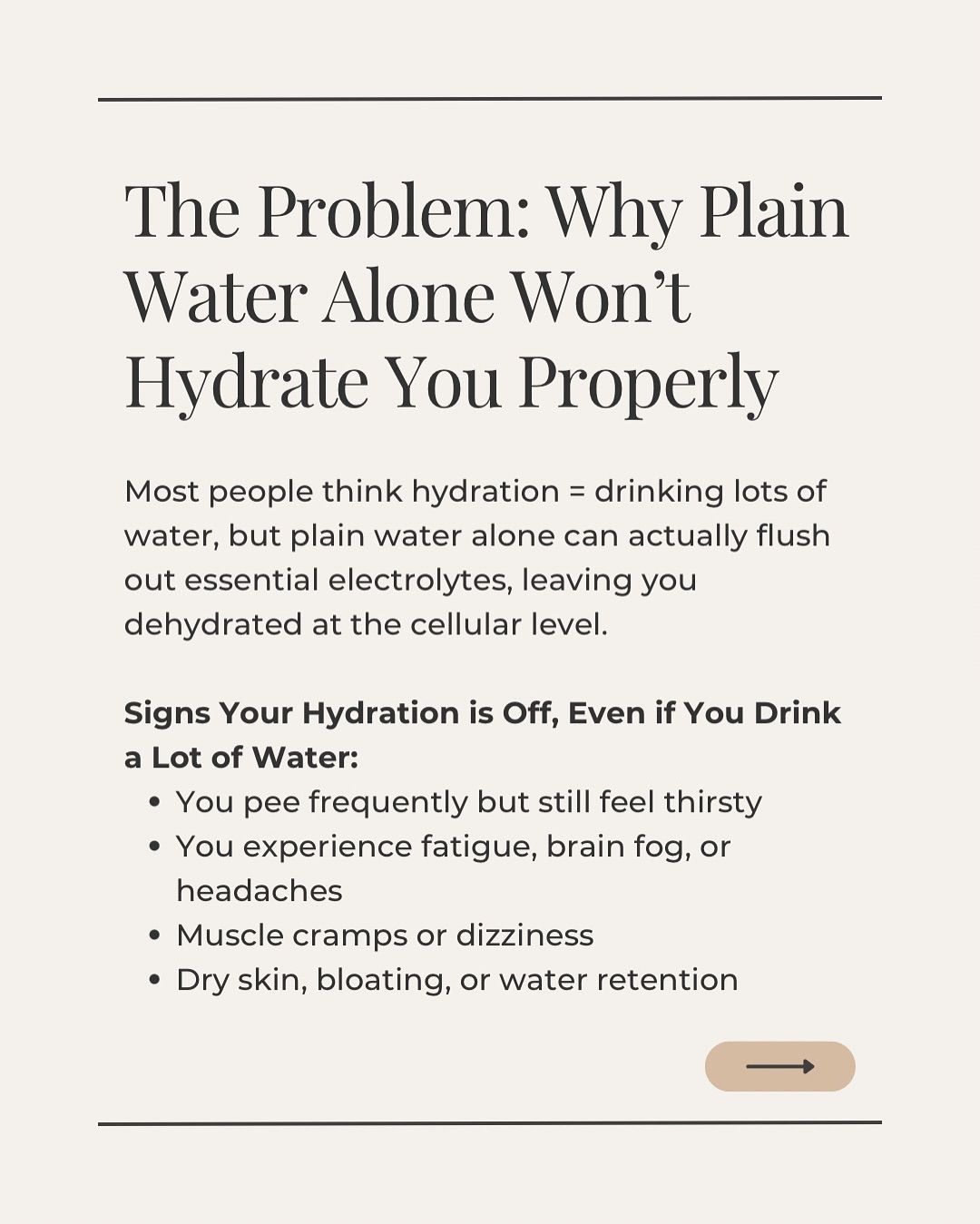

For generations, the mantra has been simple, universally accepted, and endlessly repeated: "Drink more water." It’s the bedrock of health advice, the first line of defense against fatigue, and the seemingly complete solution to bodily well-being. From childhood, we’re taught that water is life, the elixir that fuels every cell, every function. And indeed, it is. But what if this age-old wisdom, while fundamentally true, is an incomplete symphony? What if the very act of diligent hydration, when approached with a singular focus on H2O, could, under certain circumstances, betray us, leading not to revitalization but to subtle, insidious decline?
This is the story of Hydration 2.0 – a paradigm shift from the simplistic narrative of "just drink water" to an understanding of the intricate, dynamic dance between water and its silent partners: electrolytes. It’s a journey into the body’s microscopic world, where charged particles orchestrate the very rhythm of life, and where the absence of these unsung heroes can turn the purest water into a potential foe.
Our audience, knowledgeable and discerning, understands the complexities of biological systems. They know that life is rarely simple, and that even the most fundamental processes are governed by a delicate balance. This narrative will delve beyond the surface, exploring the evolutionary context, the precise physiological mechanisms, and the modern challenges that necessitate a re-evaluation of our most basic health habit.
The Primal Pact: Water’s Ancient Role, and Its Limits
Imagine our ancestors, millennia ago, traversing vast, arid landscapes. Water was a precious commodity, its discovery a matter of survival. Their bodies evolved to conserve it fiercely, to extract every last drop from food, and to utilize what they found with utmost efficiency. In those times, the primary threat was dehydration – the gradual loss of fluid from the body, leading to cellular collapse. Drinking water, when available, was an unambiguous good. It replenished lost volume, cooled the body, and flushed waste.
This evolutionary legacy has imprinted upon us a deep-seated appreciation for water. We instinctively reach for it when thirsty, our kidneys meticulously regulate its excretion, and our brains monitor its balance with unwavering vigilance. But the environment of modern humanity is vastly different from that of our forebears. We are not constantly on the brink of severe water scarcity. Instead, we live in a world of abundance, often pushing our bodies to extremes that our ancient physiology never anticipated.
Consider the endurance athlete, the laborer under a scorching sun, the individual recovering from a severe illness, or even someone simply navigating a stressful, dehydrating day. These scenarios accelerate the body’s natural processes, particularly sweating – our primary cooling mechanism. Sweat, however, is not pure water. It is a dilute saline solution, carrying away not just fluid but also vital minerals: sodium, potassium, calcium, magnesium, and chloride, among others.
Herein lies the crux of the Hydration 2.0 story. While replenishing water volume is essential, if we only replace the water lost through sweat, urine, or illness, we are effectively diluting the remaining electrolytes in our system. This isn’t just inefficient; it can be dangerous.
The Silent Architects: What Are Electrolytes and Why Do They Matter?
At their core, electrolytes are minerals in your body that have an electric charge. They are found in your blood, urine, tissues, and other body fluids. They are the microscopic spark plugs of life, facilitating countless critical functions:
- Sodium (Na+): The primary electrolyte in extracellular fluid (outside cells). Crucial for fluid balance, nerve impulse transmission, and muscle contraction. Its concentration dictates osmotic pressure.
- Potassium (K+): The primary electrolyte within intracellular fluid (inside cells). Vital for maintaining cell volume, nerve impulse transmission, muscle contraction (especially cardiac muscle), and protein synthesis.
- Chloride (Cl-): Works closely with sodium to maintain fluid balance, blood volume, and blood pressure. Also a key component of stomach acid.
- Magnesium (Mg2+): A true workhorse, involved in over 300 enzymatic reactions. Essential for muscle and nerve function, blood glucose control, blood pressure regulation, and bone health. Often overlooked, but critically important.
- Calcium (Ca2+): Renowned for bone health, but also indispensable for muscle contraction, nerve signaling, hormone secretion, and blood clotting.
- Phosphate (PO4^3-): Essential for bone and teeth formation, energy production (ATP), and buffering acid-base balance.
These ions are not passive passengers; they are active participants in a ceaseless, intricate ballet. They create electrical gradients across cell membranes, enabling neurons to fire, muscles to contract, and nutrients to enter and waste products to exit cells. Without them, even the purest water cannot perform its duties effectively.
The Deception of Dilution: When Water Alone Becomes a Foe
The most dramatic illustration of why water isn’t enough without electrolytes is a condition known as hyponatremia – dangerously low sodium levels in the blood. For the knowledgeable audience, this isn’t merely a vague term; it signifies a severe disruption of osmotic balance, often with life-threatening consequences.
Imagine an endurance runner, pushing through mile 20 of a marathon on a hot day. They’ve been meticulously "hydrating" with plain water, driven by the fear of dehydration. As they sweat profusely, they lose liters of fluid and grams of sodium. If they only replace the water, the total volume of fluid in their body increases, but the concentration of sodium decreases. The blood plasma becomes hypotonic (less concentrated) relative to the fluid inside the cells.
The body, in its relentless pursuit of equilibrium, initiates a process called osmosis. Water, following the osmotic gradient, rushes from the less concentrated blood plasma into the more concentrated cells. This cellular swelling is problematic everywhere, but nowhere more so than in the brain. The skull is a rigid container; the brain has nowhere to expand. As brain cells swell, they press against the skull, leading to symptoms ranging from headaches, nausea, and confusion to seizures, coma, and even death. This is the tragic irony: the well-intentioned act of drinking water, without the accompanying electrolytes, becomes a pathway to peril.
This isn’t just an athlete’s problem. Hyponatremia can affect:
- Individuals with kidney disease: Impaired ability to excrete excess water.
- Elderly individuals: Often have impaired thirst mechanisms and kidney function, making them susceptible.
- People on certain medications: Diuretics, antidepressants, and pain medications can affect sodium balance.
- Individuals with gastrointestinal illnesses: Vomiting and diarrhea lead to significant electrolyte loss.