
For decades, the narrative of strong bones has been a seemingly simple one: calcium and vitamin D. We’ve been urged to drink milk, take supplements, and bask in the sun, all in pursuit of a skeletal fortress against the ravages of time and osteoporosis. This well-rehearsed mantra has permeated our collective consciousness, becoming the undisputed gospel of bone health.
But what if this story, while not entirely wrong, is profoundly incomplete? What if the true architect of bone density, the meticulous conductor of calcium, has been toiling in relative obscurity, an unsung maestro orchestrating a symphony of mineral deposition that we’ve only recently begun to fully appreciate?
Enter Vitamin K2 – the often-overlooked, frequently misunderstood, yet undeniably crucial nutrient that is rapidly rewriting our understanding of what it truly takes to build and maintain robust, resilient bones. For the knowledgeable individual seeking to transcend the simplistic narratives, the journey into the world of Vitamin K2 reveals a complexity and elegance that elevates it from a mere supporting player to the real key, the central figure in the drama of skeletal integrity.
The Calcium Paradox: A Hint of Deeper Truths
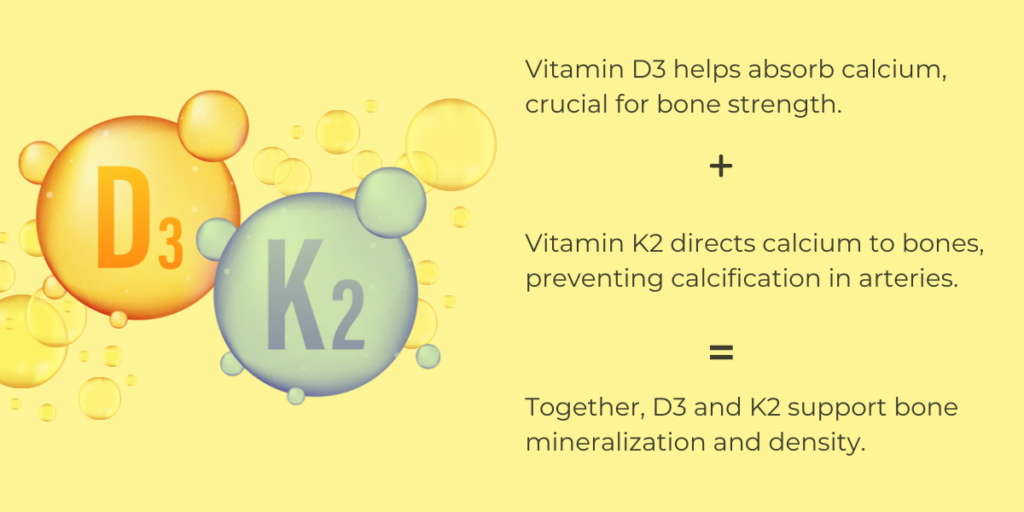
Before we fully embrace K2, let’s acknowledge the familiar players. Calcium, the very substance of bone, is undeniably essential. Vitamin D, its partner, facilitates calcium absorption from the gut, ensuring a steady supply for bone mineralization. This much is undeniable.
However, the modern era, awash in calcium and vitamin D supplementation, has revealed a puzzling phenomenon: the "calcium paradox." Despite increasing calcium intake, rates of osteoporosis and fractures haven’t plummeted as dramatically as expected. Worse, a growing body of evidence suggests that excessive calcium intake, particularly from supplements, without proper guidance, might contribute to arterial calcification – the hardening of arteries that underpins cardiovascular disease.
How can the very mineral we champion for strong bones simultaneously become a threat to our hearts? This paradox is the first crucial clue, a flashing red light indicating that something vital is missing from our understanding. It implies that simply having calcium isn’t enough; the body needs a sophisticated system to direct it, to ensure it lands in the right places (bones and teeth) and stays out of the wrong ones (arteries, kidneys, joints). This is precisely where Vitamin K2 steps onto the stage.
Unveiling the Maestro: What Exactly is Vitamin K2?
Vitamin K is a fat-soluble vitamin, famous for its role in blood clotting. But this is where the common understanding often stops short. There are two primary forms of Vitamin K:
- Vitamin K1 (Phylloquinone): Found predominantly in green leafy vegetables (spinach, kale, broccoli). Its primary function is in hepatic (liver) clotting factor synthesis.
- Vitamin K2 (Menaquinone): This is the form that holds the key to bone and cardiovascular health. K2 is further subdivided into several "menaquinones," denoted as MK-n, where ‘n’ represents the number of isoprenoid side chains. The two most studied and biologically significant forms are:
- MK-4 (Menaquinone-4): Found in animal-derived foods like certain meats, egg yolks, and high-fat dairy products (especially from grass-fed animals). It has a shorter half-life in the body.
- MK-7 (Menaquinone-7): Primarily found in fermented foods, most notably the traditional Japanese fermented soybean dish, natto. MK-7 boasts a much longer half-life, meaning it remains active in the body for longer periods, offering sustained benefits.
The distinction between K1 and K2 is not merely academic; it’s fundamental. While K1 is crucial for preventing bleeding, it has limited bioavailability for non-hepatic tissues. K2, on the other hand, is specifically utilized by bones, arteries, and other soft tissues to carry out its unique, calcium-directing functions.
The Weston A. Price Legacy: Activator X
The story of Vitamin K2’s bone-building prowess isn’t entirely new. Over a century ago, Dr. Weston A. Price, a pioneering dentist and nutritionist, embarked on a global quest to study the health of traditional peoples. He observed their remarkable immunity to modern degenerative diseases, including dental caries and bone deformities, despite diets that often lacked pasteurized milk or conventional supplements.
Price attributed their superior health to a mysterious fat-soluble nutrient he termed "Activator X," abundant in grass-fed butter, organ meats, and certain fermented foods. He noted its profound impact on bone structure, facial development, and overall vitality. Decades later, scientific research strongly suggests that Activator X was, in fact, Vitamin K2, particularly the MK-4 form prevalent in the diets of the traditional communities Price studied. His astute observations, once dismissed as anecdotal, now form a foundational cornerstone for our modern understanding of K2.
K2’s Masterstroke: Carboxylation and Calcium Orchestration
The true genius of Vitamin K2 lies in its biochemical mechanism: carboxylation. This process is crucial for activating specific proteins that, once activated, become biological "traffic cops" for calcium. Without K2, these proteins remain in an inactive state, unable to perform their vital duties.
Let’s focus on two key Vitamin K2-dependent proteins (VKDPs) that are central to bone health:
-
Osteocalcin (OC): Produced by osteoblasts (bone-building cells), osteocalcin is the most abundant non-collagenous protein in bone. However, for it to effectively bind calcium and integrate it into the bone matrix, it must be carboxylated by Vitamin K2.
- Inactive Osteocalcin: Without sufficient K2, osteocalcin remains in its inactive (uncarboxylated) form. It circulates in the bloodstream, essentially "looking for a job" but unable to perform its primary function of ushering calcium into bone.