
The crisp, clean aroma of wintergreen is an olfactory signature that transports many to frosty landscapes, the invigorating burn of a muscle rub, or the nostalgic sweetness of a childhood candy. It is a scent synonymous with invigoration, relief, and a peculiar blend of natural wonder and chemical precision. At the heart of this iconic essence lies a single, unassuming molecule: Methyl Salicylate. Far from being a mere fragrance, this potent compound, often affectionately termed "wintergreen oil," carries a rich history, a complex biochemistry, and a fascinating narrative of human discovery and interaction. This is its story – a tale of botanical alchemy, medicinal marvel, and the delicate balance between therapeutic power and perilous toxicity, intended for those who appreciate the deeper currents of chemical narrative.
The Genesis in the Green: A Botanical Overture
Our story begins not in a laboratory, but in the dappled light of North American forests, where the low-growing Gaultheria procumbens, commonly known as wintergreen, checkerberry, or teaberry, spreads its glossy evergreen leaves and bears its bright red berries. For centuries, indigenous peoples, including the Cherokee, Iroquois, and Ojibwe, understood the plant’s secrets. They brewed teas from its leaves for various ailments: to alleviate muscle and joint pain, soothe fevers, ease headaches, and even as a general tonic. They chewed the leaves for dental health and to mask bad breath, intuitively recognizing its antiseptic and analgesic properties long before the advent of modern chemistry.
This was the dawn of methyl salicylate’s human journey – an empirical understanding passed down through generations, rooted in observation and experience. The plant, a silent alchemist, produced this compound as a secondary metabolite, likely as a defense mechanism against herbivores and pathogens. Its strong odor, a warning, simultaneously served as an invitation for human curiosity and eventual benefit.
The scent, however, was not exclusive to Gaultheria procumbens. Other plants, notably the sweet birch (Betula lenta), also yield methyl salicylate upon distillation, leading to the historical interchangeability of "wintergreen oil" and "birch oil" in many early applications. This botanical commonality underscores a broader evolutionary strategy, hinting at the molecule’s fundamental efficacy across diverse species.
The Unveiling: From Folk Wisdom to Chemical Precision
The scientific chapter of methyl salicylate’s story opened in the 19th century, a period of fervent chemical exploration. As chemists began to systematically isolate and characterize the active principles of medicinal plants, the distinctive aroma of wintergreen naturally drew their attention.
In 1843, the French chemist Auguste Cahours successfully isolated the pure compound from wintergreen oil. He identified it as an ester, a class of organic compounds formed from an acid and an alcohol. Cahours’ work was pivotal, transforming an aromatic essence into a defined chemical entity with a precise molecular formula. Independently, German chemist Adolph Strecker also contributed to its characterization. This isolation marked a crucial transition: from the qualitative realm of folk medicine, where the plant was understood as a whole, to the quantitative world of modern pharmacology, where specific molecules could be studied, synthesized, and their effects meticulously dissected.
The discovery was particularly significant because it linked directly to another burgeoning area of research: salicylic acid. Salicylic acid itself had been isolated from willow bark (Salix alba) – another plant with a long history of use for pain and fever relief – by Johann Andreas Buchner in 1828 and later synthesized by Hermann Kolbe in 1874. The realization that methyl salicylate could be hydrolyzed (broken down) into salicylic acid within the body provided a profound chemical explanation for the age-old efficacy of both willow bark and wintergreen. It was a molecular Rosetta Stone, translating botanical wisdom into biochemical understanding.
The Molecular Blueprint: A Tale of Two Halves
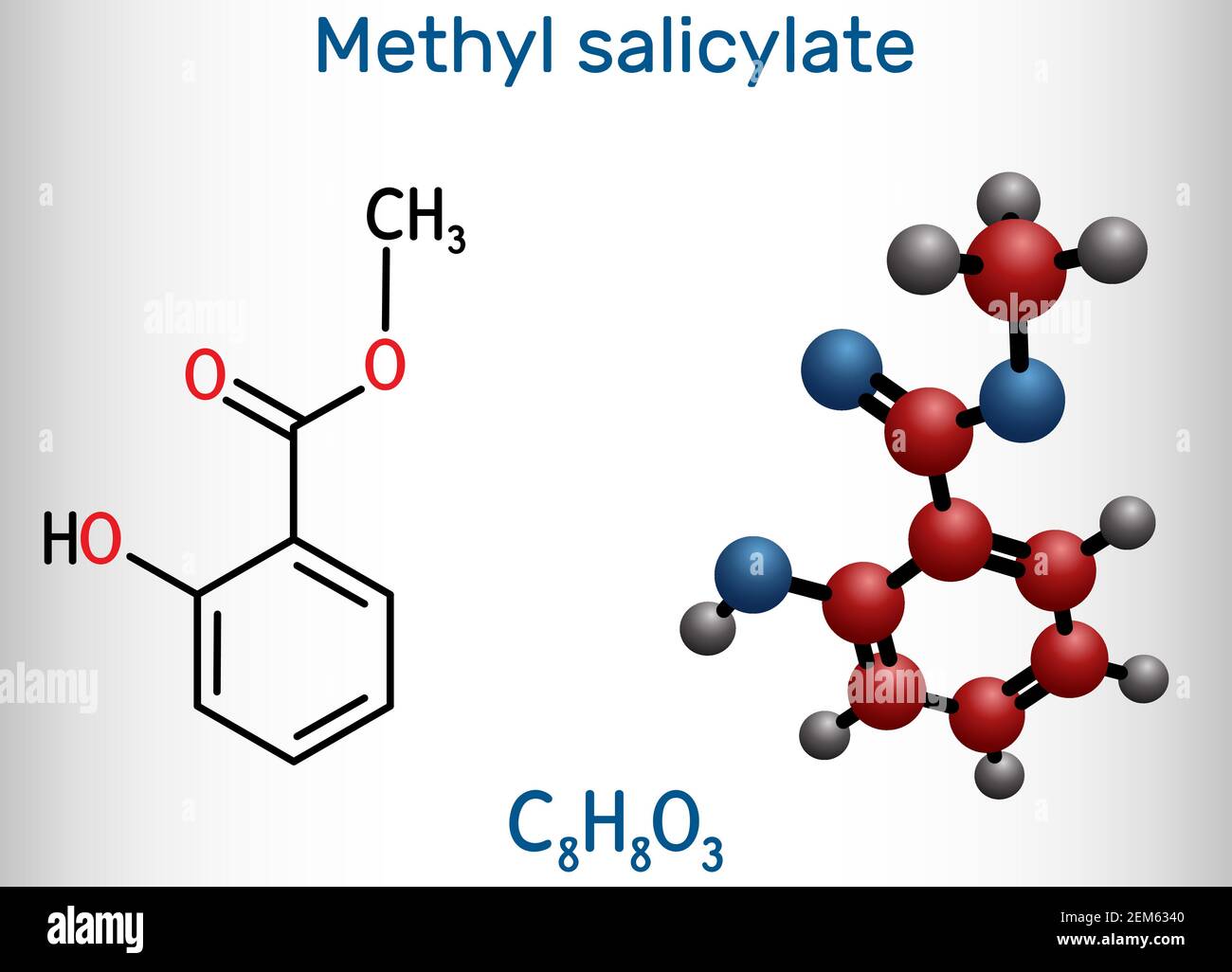
To truly understand methyl salicylate, one must peer into its molecular architecture. Its IUPAC name, methyl 2-hydroxybenzoate, offers a precise description, but let’s break it down into its more evocative components:
-
Salicylate: This is the heart of the molecule, derived from salicylic acid. It’s a benzene ring (a stable, six-carbon ring structure) with two key functional groups attached: a carboxyl group (-COOH) and a hydroxyl group (-OH). The carboxyl group gives salicylic acid its acidic properties, and the hydroxyl group, positioned ortho (next to) the carboxyl group, is crucial for its biological activity. This "salicylate" backbone is what confers the analgesic, anti-inflammatory, and antipyretic properties.
-
Methyl: This refers to the methyl group (-CH3), a small, simple alkyl group. In methyl salicylate, this methyl group is esterified with the carboxyl group of salicylic acid. An ester linkage (-COO-) is formed when an acid reacts with an alcohol, releasing water. In this case, salicylic acid acts as the acid, and methanol (methyl alcohol) acts as the alcohol.
So, methyl salicylate is essentially salicylic acid where the acidic proton of the carboxyl group has been replaced by a methyl group, forming an ester. This seemingly small modification has profound implications for its physical properties (e.g., volatility, oil solubility) and its biological fate. While salicylic acid is a white crystalline solid, methyl salicylate is a colorless to pale yellow oily liquid with its characteristic strong odor. This esterification makes it more lipophilic (fat-soluble), which is critical for its ability to penetrate skin – a cornerstone of its topical application.
The Symphony of Action: How the Whisper Becomes a Roar
The "potency" of methyl salicylate is not a singular phenomenon but a multifaceted orchestration of biochemical events, playing out differently depending on its route of administration. Its story here is one of transformation and targeted interaction.
1. The Topical Tactician: Counterirritation and Peripheral Relief
When applied topically, methyl salicylate exerts its most immediate and well-known effects. This is where it acts as a counterirritant and rubefacient.
-
Counterirritation: The initial sensation upon applying a wintergreen-containing balm is often a cooling tingle, rapidly followed by a warming, sometimes burning, sensation. This isn’t just a trick of perception; it’s a direct interaction with peripheral nerves. Methyl salicylate activates specific transient receptor potential (TRP) channels on sensory neurons in the skin, particularly TRPA1 (the "wasabi receptor") and TRPV1 (the "capsaicin receptor"). Activation of TRPA1 leads to the initial pungent/cooling sensation, while TRPV1 activation produces the warmth and burning. This localized nerve stimulation effectively "distracts" the brain from the deeper pain signals originating from muscles or joints. It’s a physiological diversion, replacing deep, throbbing pain with a more superficial, manageable irritation.