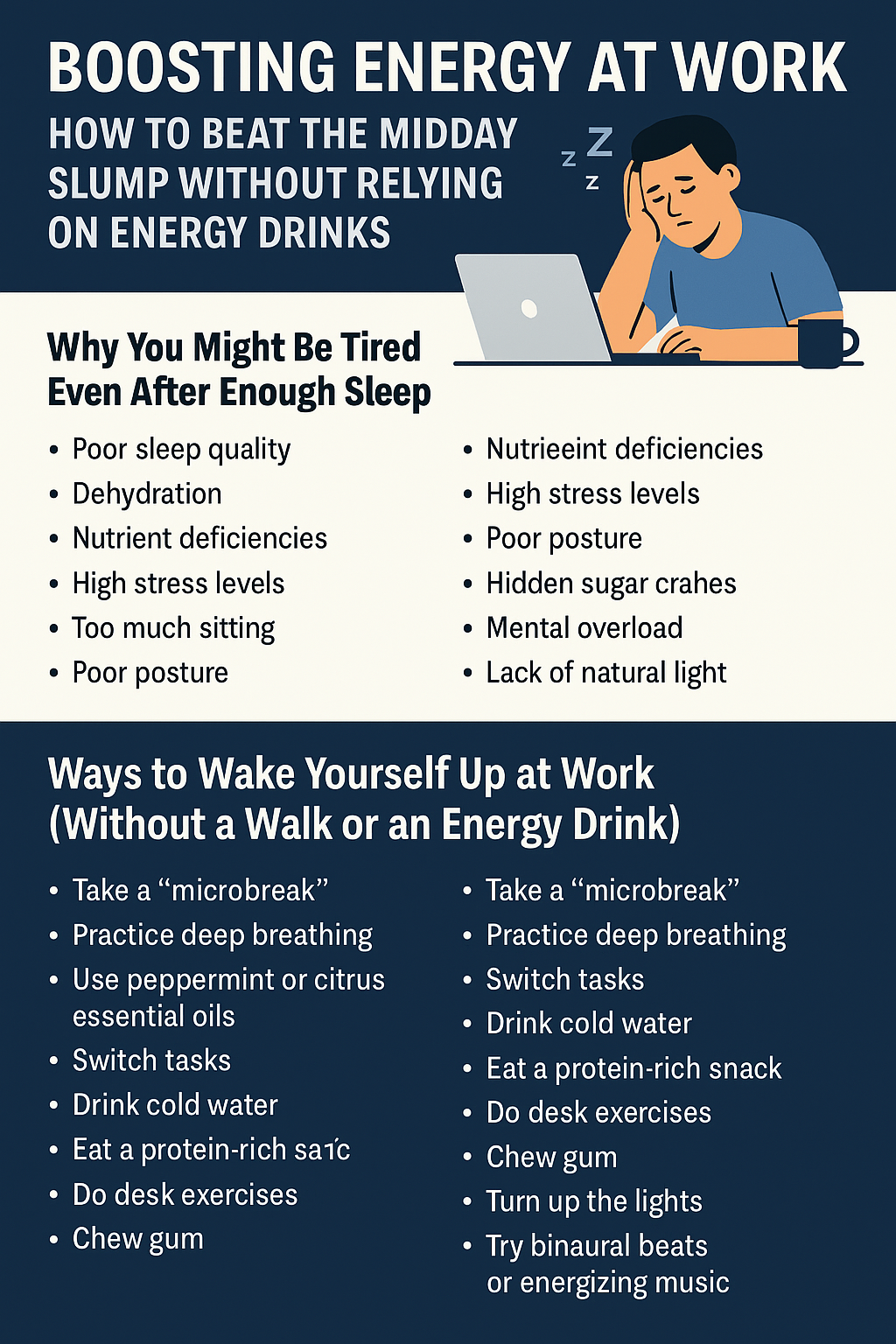

The clock ticks past 2 PM. The morning’s focused energy has dissipated like morning mist. Your eyelids feel heavy, your thoughts sluggish, and the once-invigorating aroma of your coffee now seems like a cruel mockery. This isn’t just a lull; it’s the notorious "mid-day slump," a universally acknowledged antagonist in the daily saga of productivity and well-being. For many, it’s a predictable enemy, battled with another caffeine fix, a sugary snack, or the sheer force of will. But what if this pervasive fatigue isn’t merely a consequence of a heavy lunch, a restless night, or the natural ebb and flow of circadian rhythms? What if, beneath the surface of these common culprits, a silent saboteur is at play, systematically draining your vitality?
Imagine Eleanor, a brilliant software engineer, whose days were a symphony of code and complex problem-solving. But by mid-afternoon, her mental agility would invariably falter. The elegant lines of logic blurred, and the vibrant hum of her intellect dwindled to a dull throb. She tried everything: meticulous sleep hygiene, a diet meticulously balanced for sustained energy, timed exercise, even meditation breaks. Each attempt yielded only transient relief, the slump returning with an almost defiant regularity. Her colleagues, similarly afflicted, commiserated, attributing it to the universal human condition, the inevitable consequence of a demanding modern life. Yet, Eleanor sensed something deeper, a persistent whisper of depletion that transcended the usual fatigue. She, like many others, was unknowingly navigating the treacherous waters of iron deficiency, a condition far more insidious and widespread than commonly understood.
The Unseen Architect of Energy: Iron’s Fundamental Role
To understand how iron deficiency can orchestrate such a profound energy crisis, we must first delve into the fundamental roles this trace mineral plays within the human body. Iron is not merely a component; it is an architect, a conductor, and a vital cog in the machinery of life. Its significance extends far beyond the simplistic notion of "blood building," touching upon cellular respiration, neurotransmitter synthesis, immune function, and even thyroid hormone metabolism. For the knowledgeable individual, understanding these intricate mechanisms reveals why even a subtle dip in iron stores can have cascading, systemic effects that manifest as the debilitating mid-day slump.
1. The Oxygen Express: Hemoglobin and Myoglobin
The most widely recognized role of iron is its central position in oxygen transport. Within red blood cells, iron forms the core of heme groups, which are integral to the protein hemoglobin. Each hemoglobin molecule, a tetramer of globin chains, cradles four heme groups, and each heme group, in turn, contains a single ferrous (Fe2+) iron atom. It is this ferrous iron that reversibly binds oxygen in the lungs, facilitating its efficient transport through the bloodstream to every cell and tissue in the body.
Upon arrival at the tissues, oxygen is released and taken up by myoglobin, another iron-containing protein, predominantly found in muscle cells. Myoglobin acts as a local oxygen reservoir, ensuring a steady supply for muscular contraction and metabolic activity, particularly during periods of increased demand.
The implication of iron deficiency here is straightforward yet profound: insufficient iron leads to impaired hemoglobin synthesis, resulting in smaller, paler red blood cells (microcytic hypochromic anemia). This reduces the blood’s oxygen-carrying capacity. When oxygen delivery to tissues falters, the cells, particularly those with high metabolic demands like muscle cells and neurons, become starved. The result is a pervasive fatigue, shortness of breath, and a general sense of lassitude that can become particularly pronounced when the body attempts to maintain focus or activity past the initial surge of morning energy. The mid-day slump, in this context, is the physiological manifestation of an oxygen deficit, a cellular cry for help.
2. The Powerhouse Connection: Mitochondria and Cellular Respiration
While the role of iron in oxygen transport is critical, its equally vital function within the mitochondria – the "powerhouses" of the cell – is often less emphasized but equally, if not more, pertinent to chronic fatigue. Within the inner mitochondrial membrane, iron is an indispensable component of the electron transport chain (ETC), the final and most prolific stage of aerobic respiration, responsible for generating the vast majority of cellular ATP (adenosine triphosphate), the body’s primary energy currency.
Specifically, iron-sulfur clusters are integral to Complexes I, II, and III of the ETC. These clusters are highly specialized cofactors that facilitate the transfer of electrons along the chain, a process essential for establishing the proton gradient that drives ATP synthase. Furthermore, cytochrome enzymes, which are also critical components of the ETC (Complexes III and IV), are heme-containing proteins, meaning their functionality is directly dependent on adequate iron supply.
When iron levels are insufficient, the efficiency of the ETC is compromised. Even if oxygen is present, the cellular machinery cannot effectively utilize it to produce ATP. This leads to a state of "cellular energy crisis," irrespective of the anemic status. The brain, with its extraordinarily high metabolic rate and continuous demand for ATP, is particularly vulnerable. The cognitive fog, difficulty concentrating, and the profound mental fatigue experienced during the mid-day slump are direct consequences of this mitochondrial dysfunction. Eleanor’s struggle to maintain her focus on complex coding problems, even after ample sleep, resonated with this cellular energy deficit. Her brain simply couldn’t generate ATP efficiently enough to sustain high-level cognitive function.
3. The Neurochemical Symphony: Neurotransmitter Synthesis and Function
Beyond its roles in oxygen transport and ATP production, iron acts as a crucial cofactor for several enzymes involved in neurotransmitter synthesis and metabolism. Key among these are tyrosine hydroxylase, the rate-limiting enzyme in the synthesis of dopamine and norepinephrine, and tryptophan hydroxylase, involved in serotonin synthesis.
Dopamine, often dubbed the "motivation molecule," plays a pivotal role in regulating mood, reward, attention, and executive function. Norepinephrine is critical for alertness, arousal, and the "fight or flight" response. Serotonin influences mood, sleep, appetite, and learning. A deficiency in iron can impair the activity of these hydroxylases, leading to reduced levels of these vital neurotransmitters.
The symptoms of iron deficiency often mirror those of depression and anxiety: irritability, poor concentration, memory issues, and a general lack of motivation. The mid-day slump, characterized by a sudden drop in focus and an overwhelming desire to disengage, can be partly attributed to this subtle disruption in the delicate balance of neurochemistry. For Eleanor, the feeling of her mind "shutting down" in the afternoon wasn’t laziness; it was a neurochemical reality, a direct consequence of her body’s inability to synthesize sufficient quantities of the neurotransmitters required for sustained mental acuity.
4. The Immune System’s Guardian: Iron and Host Defense
Iron is also essential for the proper functioning of the immune system. It plays a role in the proliferation and maturation of lymphocytes, the production of reactive oxygen species by phagocytes to kill pathogens, and the synthesis of various immune mediators. While the body cleverly sequesters iron from invading pathogens during infection (a process known as nutritional immunity), chronic iron deficiency can impair immune cell function, making individuals more susceptible to infections and prolonging recovery times.
A compromised immune system, even in the absence of overt illness, places an additional metabolic burden on the body. Fighting off subclinical infections or dealing with chronic inflammation further diverts energy resources, exacerbating feelings of fatigue and contributing to the overall sense of being run down. This often manifests as a general malaise that intertwines with the mid-day energy dip.
5. The Thyroid Connection: Indirect but Significant
While not a direct component of thyroid hormones, iron is a cofactor for thyroid peroxidase, an enzyme critical for thyroid hormone synthesis. Thyroid hormones, in turn, are key regulators of metabolic rate throughout the body. Suboptimal thyroid function, even within the "normal" range, can lead to widespread symptoms of fatigue, weight gain, and cognitive impairment. Iron deficiency, by subtly impacting thyroid hormone production or conversion (T4 to T3), can thus indirectly contribute to the overall energy deficit and the persistent mid-day slump.
Beyond Anemia: The Insidious Nature of Iron Deficiency Without Anemia (IDWA)
The traditional medical understanding of iron deficiency has largely centered on iron deficiency anemia (IDA), where hemoglobin levels fall below a specific threshold. However, a crucial insight for the knowledgeable individual is the growing recognition of Iron Deficiency Without Anemia (IDWA), sometimes referred to as non-anemic iron deficiency or latent iron deficiency. This is where Eleanor’s story takes a critical turn.
In IDWA, an individual experiences all the debilitating symptoms of iron deficiency – profound fatigue, brain fog, restless legs syndrome, hair loss, brittle nails, pallor, and the pervasive mid-day slump – yet their hemoglobin levels remain within the normal range. This often leads to misdiagnosis, dismissal of symptoms, or a long, frustrating journey through various specialists.
The key to understanding IDWA lies in the body’s hierarchical management of iron stores. When dietary intake or absorption is insufficient, or demand is exceptionally high, the body first depletes its iron reserves, primarily stored as ferritin in the liver, spleen, and bone marrow. Only when these stores are significantly diminished does it begin to compromise hemoglobin synthesis.
Therefore, an individual can have critically low ferritin levels (indicating depleted iron stores) and low transferrin saturation (indicating insufficient iron available for transport), yet still maintain normal hemoglobin for a period. This is because the body prioritizes oxygen transport, drawing on every last available iron atom to keep hemoglobin synthesis going for as long as possible. However, the cellular and enzymatic functions of iron, particularly those within the mitochondria and for neurotransmitter synthesis, suffer long before hemoglobin levels drop. It is this pre-anemic state that is often the silent culprit behind chronic, unexplained fatigue, including the relentless mid-day slump.
Eleanor’s initial blood tests, performed by her primary care physician, only checked a Complete Blood Count (CBC), which includes hemoglobin. Her hemoglobin was consistently "normal," leading her doctor to conclude that her fatigue wasn’t related to iron. It was only after she sought a second opinion, from a physician specializing in functional medicine who ordered a comprehensive iron panel, that the truth emerged: her ferritin was critically low, and her transferrin saturation was suboptimal, even though her hemoglobin still clung to the lower end of the normal range. This was her "Aha!" moment – the scientific validation for the invisible energy drain she had been experiencing.
The Pathways to Depletion: Why Iron Deficiency is So Common
Given iron’s critical roles, why is its deficiency so prevalent? The reasons are multifaceted and often intersect: